On Treasurehunt through the North - Part 2 - Skattungbyn
- louël

- 17 hours ago
- 10 min read
(Who prefers listening to the AUDIOVERSION will find it in the end of the blogpost)
(...)
A few days to relax and unwind. Going out in the rubber boat, fishing, playing in the sand, cooking on the fire. The blueberry bushes were full of plump fruit. These were the simpler moments of our trip. Just being. Capturing happiness, bathing in the beauty of Nordic summer nature.
Geese swam by, the call of cranes in the distance. (...) These were the last lines of the previous blog post in our trilogy. ‘On Treasurehunt through the North – All Over Sweden’.
Simply being. At one of the many beautiful lakes in Värmland.
We watched the golden glow of the evening sun on the waves when six great northern divers appeared in front of us. Their curved necks turned in our direction, then they dived back down into the depths. Many metres further out, they reappeared one after the other. Their distinctive call echoed through the silence.
Then Elouan's call: ‘Hungry! Hungry! Hungry!’ or ‘Boring!’

Yes, simply being wasn't always easy. And so we had our crises time and again in our little trio. Because our respective needs didn't always fit together. Elouan naturally has a huge need to play. And although we try to accommodate this desire to play, we two adults are simply not capable of playing the games that Elouan loves with such enthusiasm and joy. And although we tried to find places where other children might live, there have been too few encounters with kids so far.
Well, and what about our own needs? Lou wanted more time for creativity.
And me? I often didn't even know what I actually wanted anymore. My head was far too busy tackling our mission. As long as one of us was playing with Elouan, or preparing firewood with him, or playfully involving him in a repair project or cooking dinner, the other could organise something for our onward journey or have a little time to themselves. But when we wanted to discuss something important together or plan our route, for example, it wasn't that easy. Our son kept interrupting us and simply wanted us to stop talking.
He deliberately made our conversation impossible by shouting ‘blah blah blah blah blah blah’. It was probably not just his boredom that prompted him to do this. I think he could also sense our own tension. Because we had a mission that was still unfulfilled... And winter was coming.


But what was the right thing to do: continue searching around Backa Skola, getting to know people, perhaps finding a place for us here after all? Or stay in Sunnemo for a while, where we had been promised a place for the winter and where there was a girl in the neighbourhood that Elouan liked to play with? Go straight to Norway to check out the homeschooling options again? Or further north, back to Skattungbyn?
Making decisions. A never-ending riddle in our search.
Who actually makes our decisions and who should make them? I have often heard that it is the man's job to make decisions, thus creating a space for my wife to relax in. And indeed, I am usually the one who makes the bigger decisions.
Or is that just an outdated view? Where have the decisions of the leading men of the last centuries, if not millennia, taken us as humanity? Of course, one must bear in mind that these men lived (and live) in circumstances that made it significantly more difficult for them to access their feelings.
In a way, I can even identify with them. When it comes to making decisions, I often find myself in a dilemma that revolves around the following question: Do I make strategic decisions, decisions based on gut feeling, or simply decisions based on the off chance? A decision seems like a good decision to me if I have a clear feeling about it. If this is not the case, I try to be strategic. At the moment, however, it usually feels like the last option: on the off chance. Because the first (strategic) leads to mindfuck. Far too much back and forth, pros and cons, research and trying to dominate the unknown by clarifying as many unclear variables as possible. The second option (based on feelings) is overshadowed by my inner strategist and thus by my thoughts.
Whether it's Human Design, writing down the various options on a piece of paper and observing the feeling when I reveal them, or other methods. Nothing seems to work really satisfactorily. My head is far too quick to override and manipulate feelings. So I just have to decide on the off chance. And so we set the compass further north again.
Off to Skattungbyn once more!

For two days, we drove through vast forest landscapes, past countless lakes, from Värmland to Dalarna. Near the town of Mora, we parked by the large Lake Siljan. Two public rowing boats invited us to take a trip to a small island nearby. There was a charming little log cabin sauna there, which we could use free of charge. Even firewood was provided. We are always amazed by such matters of course in Scandinavia. Trust, respect and the common good are three fundamental characteristics of Scandinavian society.


Well saunatized, we finally drove on to the pretty village of Skattungbyn, where I was lucky enough to enjoy another evening sauna. Once again, the village's atmosphere impressed us with its fabulous views and countless little red log cabins. Once again, the main road with its heavy lorry traffic was a nuisance. But compared to our last visit, which was now about three weeks ago, this time we didn't stand around helplessly by the road. Thanks to the contacts we had made in the meantime, this time we were right in the middle of village life. We quickly learned that the village stretches far up the hill and is interrupted again and again by large meadows and smaller fields. Further up the slope, the main road is much less noticeable. We were able to park our caravan outside the village, in the middle of the forest, at the so-called ‘Skogmans’ (forest man's). This is an old abandoned hermitage that is often used for cultural purposes by the alternative village community, or has even provided shelter for the odd young person in need of money. Elouan and I enjoyed playing hide and seek in every corner of the farmstead or collecting chanterelles in the forest.


In general, the people of Skattungbyn live largely according to the principle of sharing and giving. People here do not need much money. Indeed, some even live on very little money as a matter of principle, in line with the idea that ‘those who have more money also consume more and thus have a larger ecological footprint’. This is an interesting concept, one that I was also convinced of at one time. Today, I believe that money also has the power to minimise one's ecological footprint, even to turn it into a negative, i.e. a green footprint. It depends on how one uses the money. Nevertheless, I must soberly acknowledge that my own ecological footprint has become much larger since I started handling more money. During my travels as a journeyman, my consumption was limited to food and sometimes clothing. Nowadays I have a car that consumes fuel, oil and spare parts, as well as a mobile phone and a computer that consume electricity and make it easy to order goods online. Could the realisation of our dream of a permaculture paradise ever reverse this situation? And is the ecological footprint still a challenge that humanity needs to tackle, or is it rather the crises that will inevitably follow that need to be dealt with?
These are questions that concern us and people of Skattungbyn. In Skattungbyn, ecological change is lived and taught.
Some things here were very inspiring. For example, we visited Jens and Anika, who bought a cleared forest area cheaply fifteen years ago and now live there in paradise. With goats, chickens, a garden, apple, pear and cherry trees. They even dug themselves a pond with a sandy beach. The houses on the property are all log cabins, which they got cheaply by dismantling them elsewhere and rebuilding them here. Some were even given to them as gifts. Where can you get that? A whole house as a gift?
We had also already had the idea of purchasing cleared land cheaply in order to heal the land and build our home there at the same time. On the one hand, meeting Jens and Anika fuelled this idea. On the other hand, we wondered whether we would be able to tackle such a decade-long project on our own, without a community, while making sure the harmony in our family constellation is doing well.
We really enjoyed the social life in Skattungbyn: there is a ‘free shop’ where people can bring things they no longer need or take something away for free. There is also a kind of unpackaged organic shop and a community-supported agriculture group. On Saturdays, a few people get together to eat food cooked over a fire, and sometimes there are even meditation or folk dancing evenings. The younger, alternative crowd often mixes with the long-established residents.
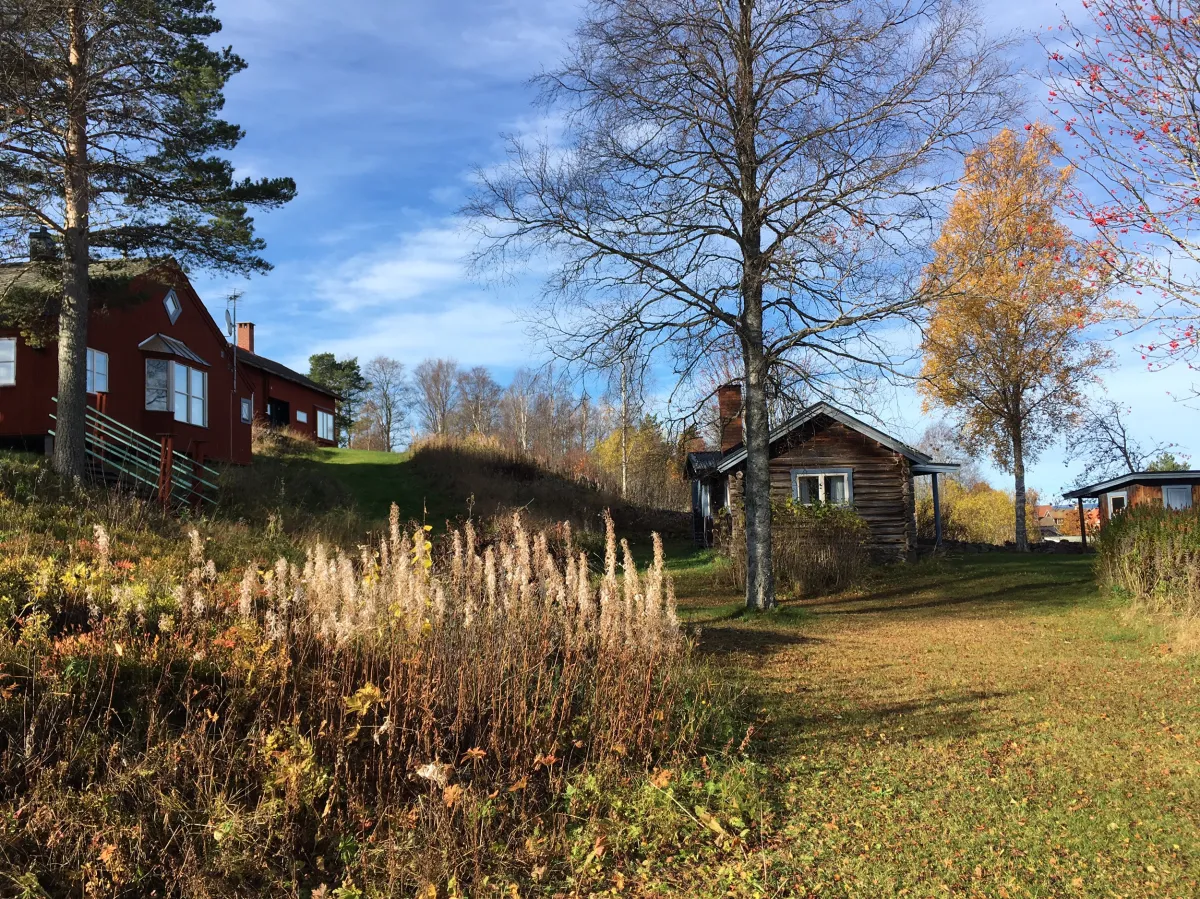


Even though the young people bring a spiritual awareness to the village, they do not seem too exotic to the original villagers, as their focus is clearly on self-sufficiency and building sustainable social structures. Compared to the spiritually oriented Ängsbacka community, everything here seemed more ‘down to earth’ to us. It is truly amazing that this village of all places is growing into a self-sufficiency mecca. After all, it is located on a north-facing slope. This means that the winters are even longer and colder than they already are in the area. However, most people said that this makes the winter particularly beautiful. The wide view to the north offers spectacular moments when the northern lights snake across the white landscape.
And even though Skattungbyn faces north, this place is still very well suited for farming. This is because many millions of years ago, a comet struck here, churning up the earth. As a result, the soil here is rich in humus, while the surrounding area is rather sandy. The inhabitants of Skattungbyn specialise in making the most of the strong sunny months to grow as much as possible in a short period of time and preserve it for the winter. Of course, hunting also serves the purpose of self-sufficiency. During our stay, moose and even bear hunting took place. However, we didn't see or hear much of it. In addition to the busy road and the north-facing slope, there is another disadvantage: the lack of living space. This is because many of the houses are used as holiday homes by people from Stockholm.
In general, we increasingly understood how much more people-friendly the Swedish and Norwegian school systems are. In the early years, there is much more focus on play. Various crafts and home economics are an integral part of the curriculum. Marks are only given in Sweden from the 6th grade onwards, and in Norway from the 8th grade onwards. In addition, mark are sometimes measured according to individual progress rather than in comparison with other children. It is not possible to repeat a year. Children are not divided into different school routes. In both countries, there are various afternoon activities where children can mainly play. And in both Sweden and Norway, one outdoor day per week is normal. Everyone has the same chance after finishing school. In Norway, primary schools often only have four, sometimes even three days of school. The remaining days can be spent either at home or in play activities organised by the school. For all children up to ‘upper secondary school’ in Norway, school ends at 2 p.m. every day. Nevertheless, there is a big difference between conservative schools and alternative schools. This is evident in the initiatives taken by parents, the focus of teaching and the way children interact with each other and with nature.

In any case, our search began to revolve more and more around the topic of school, or alternatives to it. There are plenty of attractive, affordable places to buy in Sweden. Self-sufficient farms, including machinery and tools, right on the lake with 6 hectares of land or more for less than €100,000. Half-overgrown plots in the middle of the forest with houses in need of renovation for €8,000. A few years ago, we would have given anything to raise the money and buy such a piece of land. Now, with a child soon to start school, the search became more complicated. Because all the offers we could find that would have been interesting to us were far away from a school or alternative networks that reasonably met our expectations. The more attractive places also come at a price.
However we felt that we could imagine living here in Skattungbyn. Away from the main road, perhaps in a spot that was a little sunnier. Elouan had made friends with an older boy, and we had made friends with his parents, who immediately invited us to take a shower and use their washing machine. It was really nice for us travellers that someone invited us to do a few loads of laundry as a matter of course.
It felt a little strange to leave Skattungbyn, because we liked it here. In the end, however, we felt the same way as we did in Molkom; we could imagine living here, but finding a place for us what not in the flow for now.
And in the end, it was the wind that drove us on. Because since the end of August, the warm days were over. Summer said goodbye with rain and cooler nights. Luckily, we had gas heating in the caravan. Nevertheless, it was now much more uncomfortable to live in the narrow space than it had been just a few days ago. And it was hardly going to get warmer again.
Yes, winter was approaching and we still had at least three destinations to visit. They were all in Norway: a family of friends who practise unschooling near Hamar, a friend with her daughter near Oslo, and friends in Vågå, near Jotunheim National Park. So we said goodbye to Skattungbyn for the time being.
Off to Norway!

Find out what awaited us there and whether we were able to find the treasure in the next blog post, part 3 and the finale of our treasurehunt through the north.
If you would like to support this website, our creative work and us as a family financially, you are welcome to do so. We are grateful for any appreciation and support! :)
via PayPal friends: mael.kohl@gmx.de
Or bank transfer to:
Maël Kohl, DE02430609676035039500, BIC: GENODEM1GLS
or
Louise Anika Schneider, CH9709000000319121804, BIC: POFICHBEXXX

Comments