On treasure hunt through the North - Part 1 - All over Sweden
- louël

- Dec 6
- 10 min read
Updated: 9 hours ago
(Who prefers listening to the AUDIOVERSION will find it in the end of the blogpost) (…)
“A sandy beach lined with pine trees and wide open water reflecting the light of long, glorious summer days. Silence surrounds us, tranquillity spreads through us. At dusk, the call of the black-throated diver rings out. The land calls to us: ‘Välkommen!’
Memories merge with the present. It feels like we have arrived. We breathe a sigh of relief."
(…)


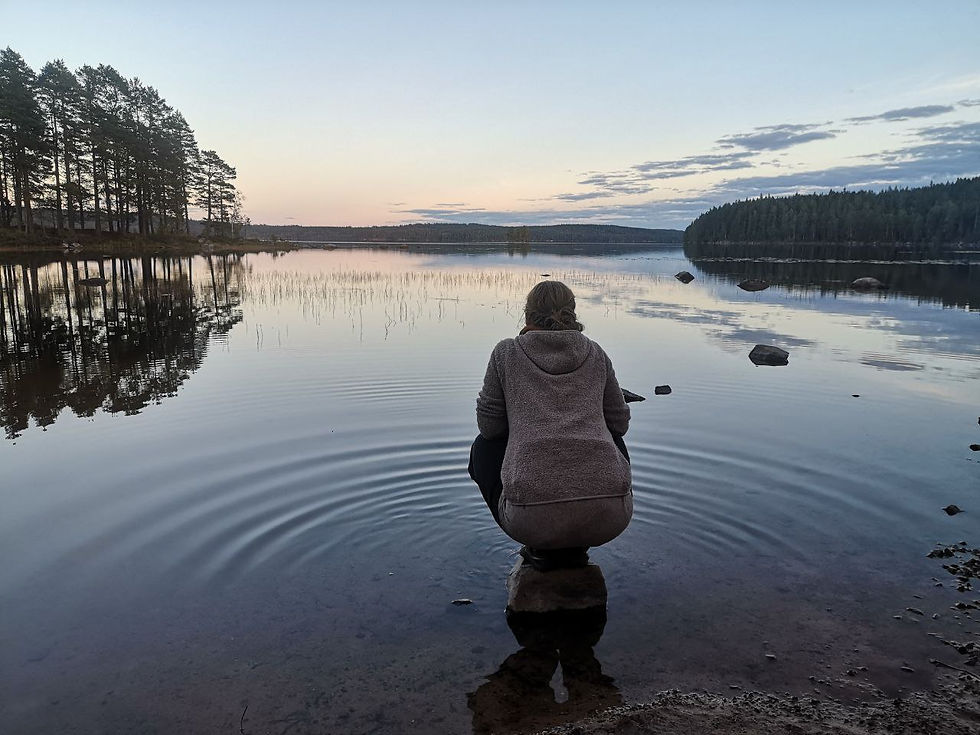
These were the last lines of the previous blog post, ‘The Call of the North’. Arriving. Breathing a sigh of relief. We were filled with joy, because it felt so good to be back at quiet lakes in the middle of the woods. Just being. Taking the rubber boat out onto the windless water. Rosy clouds on a mirror-smooth lake. Casting the fishing rod... mostly without catching any fish. Cooking over the fire. Blueberries and raspberries galore.


We could probably have spent the rest of the summer like this and had a very happy time. If it hadn't been for an inner voice tickling our feet (or the engine of our car). Because we had a mission: reality check. Is our inner call of the north just an echo of fond memories, or is it the compass needle that points us the way to our home?
Summer is already halfway over and winter is approaching...
Find a land. Or a community. A place that welcomes us and wants to be brought to life by us. But where to start?
First of all, we visited friends who had emigrated to Värmland in Sweden three years ago. It was inspiring to see their garden and how they had built their little cosy kingdom. They transformed a dilapidated house and an overgrown piece of land into a permaculture garden with a cosy home. They grow vegetables for their own consumption and even sell some of them to a restaurant. From the lake next door, they get fish and reeds to cover the roof of a future house. It's wonderful to see our friends fulfilling their dream.
From there, we drove a little further north to visit friends of friends. This was an inspiring encounter as well, as the couple had also transformed an overgrown plot of land with a dilapidated house into their own little paradise. With two new houses and a really beautiful garden.
Here we received some important information: most houses in Sweden are poorly built and poorly insulated (which is more than surprising given the temperatures here in winter). So it is best to either build a new house or buy an old log cabin in good condition and renovate it. Incidentally, building a new house is much easier in Sweden than in Central Europe. Even on forest plots where there are no buildings yet, construction is often permitted. Simple building plans, which you can draw up yourself, are sufficient for the building authorities.
But there was nothing for sale in this area at the time, so we drove on.


Already two years ago, we heard about an eco-village called ‘Solfors’ (Sun River) being built in the province of Dalarna. We discovered that the Lithica Gathering would be taking place there this year. The Lithica Gathering is a gathering of people who practise traditional crafts, in other words, crafts from before the agricultural revolution, and who are interested in other skills needed to live as part of nature. Tracking, recognising and interpreting bird calls, weather observation, stalking and much more.
The gathering arose from the vision of one day founding a community dedicated to ‘rewilding humans’. The vision inspired us several years ago, and Solfors' website also resonated with us.
So we drove further north.
Various reasons, but above all an unusual flu (if that's what it was), meant that we did not take part in the Lithica Gathering. Nevertheless, we got a taste of the Stone Age camp on an official visitor's day. People in tanned leather sat by the fire making arrows with stone tips, or stood by the river fishing with homemade bone hooks. Children ran naked along the shore and jumped into the mud, laughing.
We met a German/Swiss family who were friends of friends. They live in Norway, near Jotunheims, where they offer wilderness hikes and vision quests. Elouan and their daughter Tora got along very well from the start. They invited us to visit them. We were happy to do so.


We also met an old frirend at the gathering: Lynx Vilden (see Living Wild School). She told us that it would probably be a while before a Lithica community was established. If ever. Because although there were many interested parties, there was no real permanent group, no land and no financing options. That sounded familiar to us.
Solfors itself was such a potential piece of land. Three residential buildings, a barn, a large clearing with a garden and space for animals. Surrounded only by forest, the river and the lake. Beavers, owls, moose and bears as the nearest neighbours. Almost wild land covering 119 hectares. Very beautiful, but as long as no group could be found to live there permanently, no community could develop. And, of course, the question of ownership stood in the way.
We talked to Johan, the owner of the land. At that time, he was the only one living there, along with a handful of seasonal helpers. During the conversation, we realised that it would not make any sense for us to move here at this time. Firstly, it would be necessary to clarify whether or how the ownership situation could be resolved in the long term. Secondly, at least one other family with children would be required. In addition, Johan suffers from leukaemia and is dependent on daily assistance. With a community, it would be possible to support him, run the farm and create sources of income at the same time. But for us alone, this was hardly a good idea. We are happy to have help with everyday life ourselves.
Finally, we met a young woman named Elva. She told us about the village where she lives. Several alternative families live in Skattungbyn, so this could be a place for us.

When the visitor day was over, we drove to Skattungbyn. A village consisting of typical red Swedish cottages and, above all, traditional log cabins. The first thing we noticed was the view. The village was located on a hill from where you could see nothing but forest stretching to the distant horizon.
But how would we find the alternative families? We walked along the main road. Lorries loaded with wood sped past us. Skattungbyn did not seem very inviting to us. Finally, we found a café at the end of the village. We were sure to find someone here. However, the café turned out to be a tourist café. We didn't meet any locals. What now? I was still very tired from my recent illness, the day was coming to an end and we had no idea how to proceed. So we finally decided to drive to a nearby lake. There, by the water, we lost our trail. Where to now?
My inner instinct had led us to Solfors. But there were probably no prospects for our immediate future there. Skattungbyn had a great view, but it was located directly on a busy road. It wasn't really what we were looking for, and we hadn't been able to make any contacts. Somehow, our search didn't seem to be in the flow. We had heard about a Rainbow Gathering and another village with alternative lifestyles about three hours further north, but we didn't feel a clear yes about it. Somewhat at a loss, we picked blueberries and fished for perch.


Finally, we decided to visit a friend near Stockholm. It was a few hours' drive back south, but the idea of seeing her felt nice. Maybe something new would come of it.
Carola worked in the café at Rosenhill. A few years ago, this had been a prospective community, but now it is more of a cultural venue, brought to life by volunteers during the summer. Overflowing apple trees and music evenings characterise this place. We had hoped to meet other children there, with who Elouan could play. Unfortunately there were not families living at Rosenhill, and the few children of the visitors where there only for short time. Elouan was to shy to get in contact with them. However, he was very happy to meet Carola. It was lovely to encounter with her Carola here again. We had met her the previous winter in Italy, where she was house-sitting. At that time, she had fuelled our longing for the north with Swedish oven pancakes.
How wonderful it was to now actually be sitting together in Sweden and eating oven pancakes again. A friend of hers gave us further clues and all kinds of contacts. In fact, she also told us about Skattungbyn. This is one of Sweden's alternative hotspots, as it offers a free adult education course where you can learn traditional gardening and homesteading, as well as crafts such as weaving, throughout all four seasons.
She also told us about a town called Molkom in Värmland. There is a spiritual community there called Ängsbacka, where tantra festivals and other events take place throughout the summer. This community has attracted many alternative people to the area. Nearby was an eco-village called Sunnemo Ekoby, which focused on self-sufficiency. We also found out that there was a holistic school in Molkom.
The topic of school became increasingly important to us on this trip, and it became a complicated issue that made our search for a place to live much more difficult. School attendance is mandatory in Sweden. So if we were to officially emigrate to Sweden, Elouan would have to go to school. This was a fact that we became more and more aware of. For a long time, we thought about homeschooling. Ideally, this would be done in a community with other families, where we could support the children in their joy of learning instead of destroying it. We wanted to encourage them to pursue what inspires them and what interests them. However, we also became aware of the magnitude of this task. Without a stable community, we didn't feel up to the challenge. Furthermore, it would not be beneficial, either for him or for us, if there were no other adults from whom he could learn. Let alone other children.
The idea that Elouan would go to kindergarden and then to a school that was at least more liberal didn't feel so bad, surprisingly. It would satisfy his need to play with other children and learn lots of new things, and our need for more time for ourselves would also be met. With this freedom, it would also be easier to stabilise our financial situation. It seems that it is important to constantly question and sort through one's dreams and ideals. Full of interest, we drove to Molkom, visited the Ängsbacka community and the holistic school Backa Friskola.
Backa Friskola is a small, charming school with classic Swedish red buildings. Of course, it is not perfect and far from what we would consider ideal, but it is still a pretty good alternative. Friskola translates as free school. However, as we realised after visiting a few Friskolas, this simply means that they are privately run and not state-run. The state curriculum must still be followed.
Nevertheless, Backa Friskola has managed to integrate the idea of free learning. Part of their timetable involves students carrying out their own projects based entirely on their interests. A few years ago, a tree house was built. Right now, some boys are busy building go-carts with electric motors. Gardening is also set to become an integral part of the curriculum again. Each child will be given their own garden bed to plant. The teachers place great value on communicating with the children in a non-violent manner according to ‘Rosenberg’ and thus supporting them in understanding and communicating their needs behind their emotions.


After this surprisingly positive visit, we drove half an hour north to the Sunnemo Ekoby community.
We liked some things very much, others less so. The permaculture garden is wonderful and the café they run is also very pretty. Sunnemo is located on a gentle slope right by the lake and therefore has very good conditions for agriculture. There are several grain fields where an old variety from the province of Dalarna is mainly grown and thus protected. We arrived just in time for the harvest. Elouan was allowed to ride in the old combine harvester and even steer it. The huge machine fascinated him as much as it inspired respect in him. He decided that one day he would build a combine harvester himself. A combine harvester that doesn't destroy nature. And above all, he told us enthusiastically, he wants to become an organic farmer and keep bees.
It was nice to get to know Sunnemo Ekoby. However, there was one major criticism that prevented us from staying there permanently: only three people live permanently in the community, and one of them owns everything. It's a community concept that can only go wrong in the long run. We have gained some experience in this regard. A hierarchical structure in which one person has the potential power to kick others out overnight, even if it is not intended, inevitably leads to an unhealthy relationship field. We have experienced this ourselves, and there are plenty of examples that prove the same thing. It also became clear that there are already difficulties within Sunnemo in this regard.


We are increasingly preoccupied with the question: community, yes or no? And if yes, then how? Whereas community used to be the only way of life that really made sense to us, it is no longer our main focus. A stable and secure foundation for us as a family is now our top priority. And since Italy, it has been more than clear to us that community does not necessarily mean this, and that it can even work against it. So we continued to look for communities, but we also searched for houses or plots of land that were for sale. Unfortunately, we couldn't find anything around Molkom, so we considered moving on. Unsure whether this was the right step or whether it would be better to stay around Molkom or even in Sunnemo Ekoby for a while, we decided to take a break for the time being.


A break on a beautiful sandy beach on one of the many isolated lakes in Värmland. There we celebrated my 33rd birthday with a Petterson-style pancake cake and a rented sauna. A few days to relax and unwind. Going out in the rubber boat, fishing, playing in the sand, cooking on the fire. The blueberry bushes were full of plump fruit. These were the simpler moments of our trip. Just being. Capturing happiness, bathing in the beauty of Nordic summer nature.
Geese swam by, the call of cranes in the distance.


You can find out how our treasure hunt through the north continued in the next blog post, part 2 of our northern journey!
If you would like to support this website, our creative work and us as a family financially, you are welcome to do so. We appreciate any appreciation and support! :)
via PayPal Friends: mael.kohl@gmx.de
Or by bank transfer to:
Maël Kohl, DE02430609676035039500, BIC: GENODEM1GLS
or
Louise Anika Schneider, CH9709000000319121804, BIC: POFICHBEXXX
AUDIOVERSION:
Links: Lithica - Rewiliding Humans: https://www.lithica.earth/ Solfors Ekoby: https://www.solfors.info/ Ängsbacka Community: https://www.angsbacka.com/ Backa Friskola: https://www.backafriskola.se/ Sunnemo Ekoby: https://sunnemoecovillage.wixsite.com/sunnemoecovillage


Comments