Long bright summer days - travel through Norway and farewell songs
- louël

- Aug 14, 2023
- 22 min read
Updated: Jan 21, 2024
(If you prefer the audiobook version, go down to the very end of this blog post).

The painted clouds stretch eternally across the vast night sky.
Almost artificially, they shine in bright pink and golden glow.
In the southeast, a violet shadow. One might think it heralds the coming darkness. But in the northwest, the sky shines in unclouded blue.
It is after midnight. The birds chirp as merrily as if the day had just dawned. Presumably they are celebrating the fact that it will never really end. Because in summer, the sun hardly sets in the north. For us, it has hidden behind the mountain for two, maybe three hours before it blesses the land with its warmth again around 3 a.m.
Summer is the radical answer to the frosty, dark days of winter. The soil, soaked by melting snow and rain, is the perfect base, for the green plant friends, which stretch greedily into the endless bright sky. If they have only a short time of the year to present their green and flowery beauty to the world, they do so with tremendous power. Nowhere have I seen dandelions and coltsfoot form such huge leaves. Never before have I seen red clover reach the back of my knees.
Farmers' gardens are also exploding with fat tomatoes, endless lettuces, huge rhubarb leaves, radishes, even watermelons in the greenhouses.
The life-affirming power of the Scandinavian summer sun is the fair balance to the all-stagnant power of the long northern winter. Nature is in perfect balance. And everything is taken care of. Even in the extreme places.
Nature has also been very kind to humans: why else would there be so many birch trees in the far north, where it can be essential for us to light a fire as quickly as possible, even in ice, rain and snow, and whose bark is the perfect tinder even when soaking wet?


And just like the plants, people also enjoy the abundance of light and warmth.
They stream out of their winter caves, and already know: the next winter is coming. Therefore, there is much to do: Repairing roofs, cutting hay for the animals, making progress in the garden, making wood, celebrating festivals... Summer is the active season. There is plenty of time to relax in winter, when everything is asleep.
While during the winter months we hardly made contact with the locals, in the summer we suddenly met all the people we had wished to meet.
There are Sil and Ebbe, for example, with their daughter Gaia. We visited the Colombian-Norwegian family on their permaculture farm "Taiga Food Forest". With them we were not only allowed to get an idea of what and with what tricks you can plant in Norway, but most importantly we found friends in them. Together we celebrated Lou's birthday for a week by having cake after cake. But not only cakes, also homemade falafel, sourdough pizza and much more we could enjoy. Lou herself could only enjoy a little of all the delicious things that were baked and cooked, because a summer flu had robbed her of all taste. So she concentrated mainly on the texture of the food and mostly praised it highly.
It was certainly great for Elouan to find a playmate in Gaia. She was happy to sit with him on the sofa and read to him. Whereby she probably thought up what was written in the book.
But it was often not easy for Elouan either. After all, he was used to being able to play in peace with everything that surrounded him. That there was suddenly someone else claiming toys, or even the trampoline bouncing, for himself was difficult to bear at first. But soon he was even sharing daddy's arm.
But the excavator was particularly exciting for Elouan. Ebbe was preparing the garden for the planned permaculture paradise. So, under Elouan's watch, he shoveled earth back and forth late into the night, leveling areas or digging trenches for water channels.
Even today, he sometimes tells us how Ebbe fell over with the excavator. That was a shock for all of us. But with winches, and skillful excavator guidance, Ebbe managed to get the borrowed excavator back on the ground in no time.





Yes, there was a lot to experience at Taiga Food Forest. And we liked the shared life there. But we were drawn further north, because we wanted to explore other areas.
So we soon visited our Finnish-Norwegian friends Jo and Pauliina with their son Lillebjørn. We already knew them from last summer, and since their home was more or less on our planned route, it was clear to us that we would visit them again.
There Lou was healthy again and could taste, which is why we had another cake. Yes, as I said, with the Norwegians the summer is the month of actions, but above all also of celebrations.
So there was extensive feasting, sauna, and the hot tub was heated.
The summer had arrived meanwhile fully and completely, in the high north. Everywhere it blossomed and buzzed, in extensive splendor. The bumblebees and bees flew eagerly from fireweed to clover, lupine and rose. Everything was buzzing, vibrating, alive.
For Midsommer, which was rather a dark day due to a continuous rain including thunderstorm, we cooked over the covered fireplace. We wore flower crowns on our heads, just as one imagines a Nordic Midsommer celebration. There was also sauna once again, which we had to thank mainly the Finnish Pauliina. For her it is the minimum to have a sauna once a week. Even on the hottest summer days.
She told us about her cousin who helped in a peace project in the Sinai desert in Egypt. There, too, the Finns had built a sauna in which they regularly went to sweat.
They say about the Finns that the sauna is the first thing they build. After that, the house is built around it.


Another family had moved onto the property: Miri, Forest and their then seven-week-old daughter Ronja, whom we immediately took to our hearts. They lived for the summer in a tent with a wood stove, with a magnificent view over the valley.
We had a lively exchange with them, because our ideas of community life, and especially of accompanying children, are similar in many areas.
So we were thrilled when they told us that they were going to a family gathering where other families with nature-based community visions and homeschool interests could be found.
We knew immediately: we had to go there! However, it was to be northeast of Trondheim, which meant a long drive a good bit further north. Because of our financial shortage, we didn't know yet if it was a good idea to take the big trip.
But the next day this question should relax.
That morning Elouan slept longer, which gave me the freedom to do an extensive morning ritual consisting of meditation, yoga and nature contemplation. After that, I felt really connected to the river of life and the perfection of being, and was inspired to send a prayer to the universe: the wish for a flow of money that would come to us in a simple way.
Shortly after, Elouan woke up. I went into our camper to hand him his water bottle. The next moment there was somebody knocking at the door: It was Lynx, the neighbor with whom we had attended the wilderness course the year before. She called out: "Hey, good morning! I'll give you 1000 Euros in cash, when you take care of my horses for the next 10 days, how does this sound?"
It sounded wonderful! Lou was still a little sleepy and overwhelmed, but it didn´t took us long to say yes. Especially because Lynx had just put the money in our hands already.
Sometimes it can be so easy!
So it happened that we slept next to the horses for 10 days, gave them a bale of hay every now and then, and enjoyed the beautiful view.
There were also chickens to feed, which in return gave us some of their eggs. It was actually as if they would put us selected, fresh eggs on purpose. Because these lay constantly before the nest, while they defended the eggs, on which they sat, vehemently. It did not take long before the baby chicks started to hatch...


With a bunch of cash in our pockets, we finally drove north for two and a half days in ease and joy to get to the Family Gathering. It was really a nice drive and for the first time in a long time we felt like we were really on vacation.
We chose the route between Femundsmarka Nasjonalpark and Forollhonga Nasjonalpark, passing through the old settler and mining town of Røros. On the way, we marveled at long mountains with snow hanging on their slopes. We drove through rustic forests, which consisted of small, gnarled birch trees. And we saw a moose, as well as reindeer.
These beautiful animals looked to us like a mixture of deer and sheep. In small herds they constantly ran onto the road, which helped us to continue our journey at a relaxed pace.
After crossing a pass, we entered a valley whose spruce-rich slopes partly reminded us of the Swiss mountains. Except that the old houses were typically Norwegian: traditional log cabins whose roofs were sealed with birch bark and greened over. On the older roofs even small birch trees grew, which gave the cottages a very magical look.
We passed lakes with long sandy beaches, which radiated such a summer idyll that we could not imagine how this landscape had looked just two months ago, when it had been covered with ice and snow.


Finally we arrived at the fjord of Trondheim.
It is an interesting area. Because although it is already very far north, it is possible to grow more crops here than in the Norwegian inland further south. This is due to the warm currents of the Gulf Stream that influence the climate around the fjord, which extends far inland.
At the edge of the fjord was our destination: a small farm at the end of a gravel road.
Here the Gathering was to take place for five days, to which families from all over Norway traveled. Some came from the immediate surroundings, others from the mountainous and fjord-rich west coast, and still others from far away on the east coast, near Oslo.
They were all united by an interest in networking with other alternative-minded parents. Some have the desire to start a community, others wanted to know more about homeschooling, or share their experiences in it.
Homeschooling is not a problem in Norway, which made this country even more attractive to us. The host family itself does not teach their children in the classical sense, but simply supports them in their interests, so that the children can develop freely.
They teach themselves a lot or teach each other as well. If we had not been convinced of the idea of free education or "unschooling" before, this family would have opened our eyes. All three boys, between the ages of five and eleven, could speak good to very good English, for example, and could also read. This was simply due to their own joy of learning and the fact that there were always visitors from other countries who landed on the farm through Work-Away. The children did not seem to us to be particularly gifted, but simply naturally interested.
The only problem that many home-schooling or unschooling families in Norway have is the large physical distance between the respective families. Therefore, the interest in communal living is great. And that's probably why this Gathering was started.


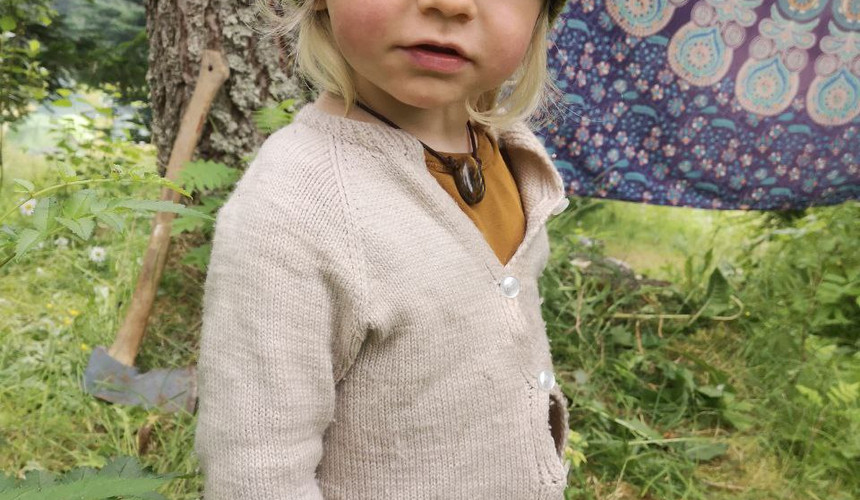


It was wonderful to see Elouan with so many children. Even though most of them were a bit too old for him, it still happened that he played with another child or ran after them to discover the trampoline, a climbing tree or the slide. But again and again he had to learn the harshness of community life when a child took away the toy he himself was about to play with.
There was not really a fixed program at the Gathering. Basically, it was mostly a nice, communal get-together, with fires, music, and making hay together.
Only the mother's blessing for one of the pregnant women, was planned firmly. And so it happened that the women were among themselves for a day, while the men went to the river with the children.
What exactly happened at the mother's blessing, I guess Lou will have to tell you. All I perceived from a distance was a great vibrating field of joy, sisterhood, gentleness and strength.
And colorful it looked, the circle of women, in the flowery meadow, under the protective tent roof.


(Most of the photos of the Gathering were taken by Janne. Feel free to check out her mystical homepage and have a look at her photography: https://www.voiceofnature.earth)
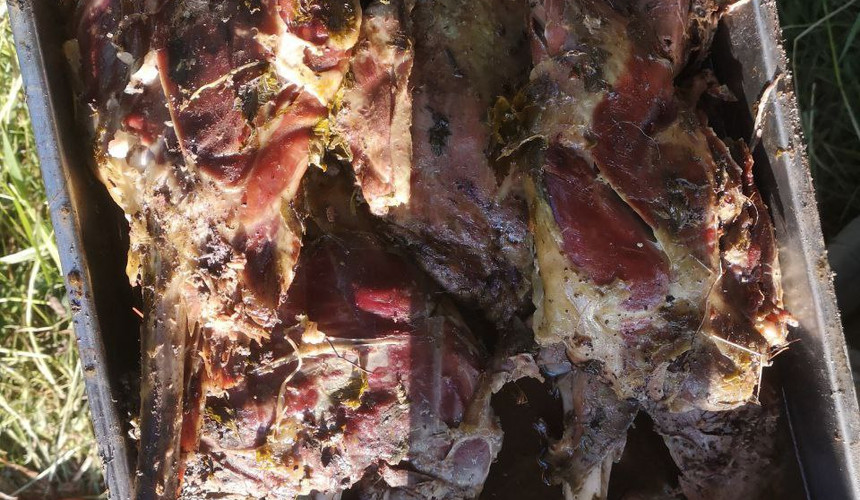
I myself prepared the dinner together with Forest and one of the other dads. It should be something very special: Self-hunted deer, as well as meat from the own sheep, cooked for hours in the earth oven.
We digged a big hole for this, lined it with stones and lit a big fire, which we kept going for some time. When it had burned down, we removed most of the embers and scattered a layer of earth in it. On top of this we then placed the flavored meat, which we had packed with large coltsfoot and dandelion leaves. Finally, we shoveled everything back in and waited patiently for about five hours.
Then there was a celebration feast. The again dug out meat was juicy tender and tasted excellent to all present.



Meat. Eating animals. A sensitive topic at many alternative events. Since Scandinavian life has shaped us a lot in terms of our diet, we'd like to touch on it a bit. Because just a year and a half ago, we were strict vegans for ethical reasons. We've been questioning that more and more as we've lived with Scandinavians, and things have changed over time.
While we are used from alternative "Gatherings" or festivals from Europe that exclusively vegetarian to vegan food is on the menu, there was here mainly meat, butter, yogurt and eggs. But especially in the north, this diet makes more and more sense for us. Winters here are harsh, people burn more fat, and when it comes to self-sufficiency, animals are very quickly in play because the garden doesn't give you anything all year round. Besides, what is more ecological: soy from monoculture farms, coconut milk from Malaysia, bananas and avocados from Chile, nuts from Israel, or the self-hunted moose, as well as berries from the forest in front of the door, the fish from the river next door, the meat of the own animals, the eggs from the chickens, the milk from the cows, or goats, in addition vegetables from the own garden?
Humans need fats, proteins and of course other nutrients for a healthy lifestyle. There are some plants that, if eaten in large masses, provide you with enough of these nutrients. But these plants do not grow easily in Norway. Nor in Germany or Switzerland.
For us, it often seems useful to look at how people lived before they became adulterated in civilization, and globalization. Fortunately, some indigenous peoples still exist today, even if comparatively few, who live in harmony with nature. To our knowledge, even in the tropical regions, where it would be easy to live only on fruits, vegetables and seeds, there is no people who do not have animals on their menu. In most peoples the babies are given liver, or also brain as the first solid food to the meal, since these contain particularly important nutrients for the development of the small humans.
How important it really is to eat animal products, or how healthy a long-term vegan diet finally is, we can probably only find out by different people going different ways and gaining experience.
It wasn't that long ago that we couldn't imagine eating animals at all.... Lou was vegan for about ten years. Also during pregnancy. Elouan seems very healthy, happy and lively. So it seems quite possible to live a healthy vegan diet.
Nevertheless, in the past 13 months we have become more and more comfortable with a regional animal product diet. In the meantime, it even seems far more sensible to us. While we lived almost vegan before, we now no longer shy away from sinking our teeth into fatty meat. On the contrary, we thank the animals for allowing us to be part of the regional ecosystem.
Which, of course, we, as travelers, are unfortunately not really. Or only occasionally.
Somehow, nomadism is in our blood. For many millennia humans have traveled around, always in search of the best hunting grounds.
Nowadays, however, there are no more large herds of animals to follow. The nomads of civilization live from the supermarket. A circumstance which makes the life of travel less and less attractive. Because eating animals, or actually any food, from the supermarket still does not correspond to our ethics.
In general, of course, we always ask ourselves this question:
Who are we, as humans, to take the lives of other animals to eat them? What right do we have to do this if there is another way?
But don't we inflict almost greater suffering on animals when we destroy their habitats because of a vegan-globalized diet?
Nutrition is apparently no simple topic, but it seems to us in the meantime simply meaningful to eat if possible that, which humans ate already thousands of years ago in their nature condition. Especially since these people did not suffer from tooth decay or other nutritional ailments. But buying meat in the supermarket is not a desirable option for us.
Were it are actually the meat industry, the mass animal husbandry and Co, which brought the meat consumption so much into disrepute and for us not attractiv at all for such a long time period. The closeness and respect for the animals that nourish us is probably the most important thing for us in terms of meat nutrition.
Nutrition in general is probably one of the biggest points for us why we strive for sedentariness and self-sufficiency. Only then, it seems to us at the moment, can we take the next big step out of sovereignty into living in harmony with nature.
I've drifted off a bit, but here we come full circle again.
Because while we still had great difficulty a year ago to imagine ourselves in a self-sufficient life in Scandinavia, and thus to live to a large extent from the animal, has moved in the togetherness with Norwegians, so much in us.
Especially Norway seems to us in the meantime as an extremely attractive country for self-sufficiency, if you are okay with hunting and fishing yourself and maybe living with a few animals.
So it was enriching for us to meet some people at the Gathering who actually live to a large extent from the food of their own farm, the forest and the waters.
In addition, in Norway the grasslands of the animals, as well as the waters and forests, are for the most part free of industrial pollution. It can be lived there thus excellently healthy and ecologically, as long as one does not intend to feed from the supermarket. Then you are much better off in Germany. In no other country have we experienced such an unhealthy choice of food. All the more, of course, it increases the will to provide for yourself.


But now enough of the nutrition topic and the advertising for emigrating to Norway.
There is another event that I would like to share with you.
After the Gathering, I was invited to go on a canoe trip with five other fathers, while the women stayed on the farm with the children.
For one of the dads, it was the last chance to experience such an adventure before his fourth child was born. For others, it was the first trip without children at all. Even I myself have not been without Lou and Elouan for a single full day since my Vision Quest 2021.
It was a strange feeling to leave them both on the farm. But fortunately I knew they were in good company.
At first, I expected the two and a half days to be a respite from the daily grind of being a father. But already the first night turned out to be a big challenge. The shore where we rested was full of gnots. Gnots are nasty flies the size of a grain of sand that swarm over you and make mosquitoes suddenly seem harmless. The biggest problem: Gnots are so small that they simply fly through the meshes of conventional mosquito nets. I had a suitable net with me, but it had been damaged from all the camping in blueberry bushes. I could hardly close one eye that night. It was a constant back and forth between hiding in the sleeping bag, gasping for air and Gnots-in-my-face-slapping.
However, a refreshing dip in the ice-cold waters refreshed me the next morning and I looked forward to continuing our tour. And it really was a beautiful route, through wilderness and silence.
Had we complained in the last blog report that even in the north it was hard to find really completely silent places: Here it was, the silence!
And the landscape was beautiful.
The first day we crossed a huge, glassy lake, which was surrounded by mountains shining in the late sunlight. The wild land gifted us with its full splendor. The lake was like a beautiful gate, out of civilization, into a perfect, untouched, but also treacherous world. The mirror gate, the lake, led us at its westernmost tip to our further way through the wild land; A river, at which mouth we set up camp for the night.
Late into the night we sat around the campfire, its damp wood giving off enough smoke to keep the gnots away.
One of the men revealed to us a piece of wisdom from his grandfather: if you wanted to be successful at fishing, you had to sacrifice something that was important to you. So he poured a full glass of his whiskey into the river and asked for a successful catch for the next day.
And another tradition of this area I should get to know: "Moonshine Coffee". You put a coin in a cup, pour coffee on it, and pour so much of the regional liquor (so-called moonshine) behind it, until the coin becomes visible again. Skol!
As the night went on, we told each other stories, got to know each other better, and drank Moonshine Coffee to the sound of Jew's harp music.
Whoever now imagines an idyllic picture of free men under the clear starry sky has not yet been to the far north during summertime. Idyllic it was, and free we certainly felt, but it remained almost daylight, so it was hard to say when we finally went to bed. But we didn't care, because we had decided to be on this trip without time.
The next day we followed the river downstream. Fortunately, three men in our group were experienced with the Canadian, so we were able to split up well among the three boats. Because the river was shallow and the current was strong, so it was always a matter of weighing up which route to take. And again and again we were surprised by rocks sticking out of the water or hanging trees, which the current was pushing us towards. Often you had to pull the canoe around in a flash, or even pull your heads in and hope that you slid under the branch without capsizing.
When the river became calmer, the next challenge appeared: pouring rain, even thunderstorms.
Just in time we found shelter under a low-hanging spruce.
One minute longer on the open water surface and we would have been wet up to our underpants.
Still, after a good hour, some of us were so soaked that we decided to just keep going.
And then came a gift of the river: On a riverbank lay a fishing rod, including hook and lure. None of the people who had already passed by had noticed it, and since I was the only one in the group who didn't have his own fishing rod, it was probably meant for me. It was not long before I had a trout on the hook. Since we didn't have any dinner in our luggage for the day, it was high time that we caught some fish.
After all: In the evening four trout sizzled over the flames, why we were drying ourselves.
For this night I smeared a mosquito protection from natural raw materials into my face. And indeed: I was allowed to sleep. So deep that I probably didn't notice how long the sun had been shining in my face. When I woke up, my skin was burning and would flake off in the days to come.
After an extensive breakfast we paddled further downstream. By now, the river had become large and wide, and it was rarely necessary to watch out for rapids. But since this river eventually led into a huge waterfall, we had to take evasive action: About five hundred meters we carried and pulled the canoes through a wonderfully wide swamp area. The biggest challenge here were the hidden water holes, in which one could easily sink up to the thigh.
Soon we came across another river, which we had to follow upstream. The current was not strong, but the dark amber waters were often not deep enough to paddle. And so most of the third day consisted of pulling and carrying the canoes. As I said, this tour was not relaxing. But it was exactly what most men need from time to time: An adventure, in which head and body are needed.
Soon the first major signs of civilization appeared: In the middle of the wilderness we came across a hut, which was comparable to the alpine huts in Switzerland. There we took a break, pancakes and coffee were served.
In the further route of our tour, sheep and cows standing on the shore were to stare at us more and more. They grazed comfortably on seemingly untouched meadows, between gnarled birch and alder trees.
But that these forests were still wild, should soon be shown to us: Suddenly one of our group, which had walked along the shore, came across a torn sheep. Since there should be no wolves here, it was guessed on bear or lynx. Whatever it was, there was not much left of the sheep. A dark red stain on green moss, and widely scattered bones.
It was an exciting feeling to know for the first time that there were larger predators living here than the pesky gnots.
At some point, after dragging forever in the drizzling rain, we spied something large and white in the distance. A car. And sure enough, suddenly we were in a hiker's parking lot, with a bus and trailer waiting for us.
Even though it was only two and a half days, it was a nice feeling to be back at my beloved ones to embrace them.
While we men were experiencing our canoe trip, the women had had a completely different adventure: A birth. Since the child was not expected for a long time, however, the birth did not take place on the farm as planned. But to everyone's relief and joy, a healthy boy was born without complications.
So we all had a lot to tell each other. But for us men, you could see the effort and lack of sleep. Soon the first one fell asleep sitting on his chair. And I, too, was happy to lie down in the gnot-free bed and take the canoe trip with me as a beautiful memory.


When Lou and I looked at the map for our further planning, we realized that we were now closer to the northernmost tip of Norway than to Zurich. While the far north had always seemed very far away before, it suddenly seemed within reach. It would probably have been four to five more days of driving. Something in us would have loved to drive further up, but already set appointments in Germany and Switzerland were hard for us to imagine canceling again.
Nevertheless, we drove four more hours north, near Steinkjer, to get to know a property.
A property that might one day become Lithica Land.
Lithica Land?
Lithica Land is to become a collaborative "Rewilding Humans" project. The vision comes from Lynx, which has been striving for decades to reunite people with nature.
The idea behind Lithica is a really exciting concept that resonates with us on many levels.
The basic idea is this: Three zones.
Zone 1: Modern Zone. Here you can find all the modern technologies, machines, cell phones, electricity, but powered by renewable energies if possible. This zone should serve as a gateway between modern civilization and Lithica Land.
Zone 2: Zone of change. Here, seminars and workshops will be held in which people will learn skills to live in the wilderness again. Also, the idea includes that there is a village here, where people live in simple, electricity-free dwellings, with limited modern technology. Partly there will be gardens, partly people will feed on hunting.
Zone 3: The wilderness. This is the largest zone. It is desired that people stay here only if they have discarded any modern utensils. This means that either they carry self-made clothes and tools made of natural materials, or they are naked.
We like the vision of dissolving the boundary between man and wilderness again, thus ensuring the cornerstone for the continued existence of wild nature in the coexistence of man, so it is very similar to our own vision.
We do not know if we personally will ever be able and willing to live like the hunter-gatherers of our ancestors. But that is also not the unconditional goal of this project. Rather, it is basically about dedicating ourselves to a movement which, at best, will be carried on by many more generations and thus contribute a direction in the great change. In the hope that the knowledge it takes to truly live in harmony with nature will not be lost and will be spread again.
We also don't know yet whether we will eventually become residents of Lithica. It is still too unclear who the other settled people there would be, and that is ultimately the deciding factor for us: That the social framework, the village, the tribe, is right for us.
Even though many things are still very unclear, not only for us personally, but also for the entire project, it was exciting to feel our way into a potential land.
And it was definitely worth a visit. The 280+ hectare land starts at the end of a dirt road, at a cluster of houses, and then stretches down a valley. Most of the forest has been untouched for many years. We discovered plenty of elk tracks there, along with beautiful gnarled trees, and had it been later in the year, we could have filled our bellies with blueberries.
The wild creek is probably the most spectacular thing about this property: it meanders through the valley from the mountains, plunges down as huge waterfalls in several places, forms small pools again and again, and at one point disappears underground again for a while.
We followed this stream upstream until it almost became a small river, which springs from a lake. A beautiful lake, in a rocky, barren landscape, just below the tree line. However, since it was a very stormy day, we did not stay very long on its shores, preferring to fish on the river. In fact, it was not long before he gave us a trout, which refined our dinner.
We would have loved to explore the country more, but the wind and additional rain soon had us returning to our motorhome. It certainly would have been exciting to explore the property all the way up into the mountains, where it eventually ends in the vast wilderness that stretches all the way across the Swedish border. Except for Sami reindeer herders with their herds, there are many many deserted kilometers here, between Norwegian and Swedish civilization.


If you want to learn more about Lithica, you can check out their website: https://www.lithica.earth/
Back in civilization, we began our intensive return trip to the south. Over a week this trip should last.
This time we chose the route between the higher mountains of Dovrefjell and Rondane Nasjonalpark. Again we were reminded of Switzerland, except that the landscape seemed wider and the grounds were littered with reindeer lichen.
We visited our friends Jo, Pauliina and Lillebjørn again for one day. We also paid another visit to Lynx. She gave us as a farewell gift her book "Return - A Journey Back to Living Wild", which she published a short time ago. A really interesting and beautiful book, very poetically written.
On the onward journey we stopped for a short dinner at Sil, Ebbe and Gaia.
It was very nice to meet again some of the dear people, to say goodbye and somehow to have the feeling with all of them to see each other again soon.


Finally, we crossed the border into Sweden, driving through beautiful Värmland and Dalsland. When we arrived at Uddevalla, a medium-sized town, the first culture shock hit us. I, in particular, had somehow not been prepared to be back in masses of cars and a world dominated by fields and roads.
We had a ferry to catch in Halmstadt, but we still had one day as a buffer. And so we made a fallback: Again a bit to the north, to one of the many idyllic lakes of Dalsland.
There we spent the following day to prepare ourselves for the time to come.
The last deep breaths of the fresh air of the car-less north. The last big gulps from a natural lake, far from any conventional agriculture. The last moments of the peaceful silence of the vast forest.
The rich nature of the north gifted us once again with its abundance; just above the lake, blueberry and raspberry bushes grew rampant, carrying plump, sweet and sour berries.
Cooking by the fire one last time.


We spent the evening before our onward journey in a cozy atmosphere. Elouan fell asleep in Lou's arms while Maël played the guitar. We sang farewell songs, promising to come back.

Take a breath. Lean yourself back. Imagine you sit with us, under pine trees, next to the shore of a lake, starring into the bright flames of the fire. Click the File below and listen to our farwell songs, if you like:
(For the recording of the blog post scroll down even more)
Do you like to support us on our family journey?
We would be very thankfull. You can do this either by bank transfer Name: Mael Kohl, IBAN: DE02430609676035039500, BIC: GENODEM1GLS
Friedhofsweg 1, 35041 Marburg Or by PayPal Friends: mael.kohl@gmx.de
If you want to be kept up to date about new blog posts, follow our Telegram-channel:
louël - our life journey https://t.me/+ZzIlydfDdLAxYTAy
Or check us out on Instagram: louel.louel https://www.instagram.com/louel.louel?r=nametag
Recording of the post:

Comments